
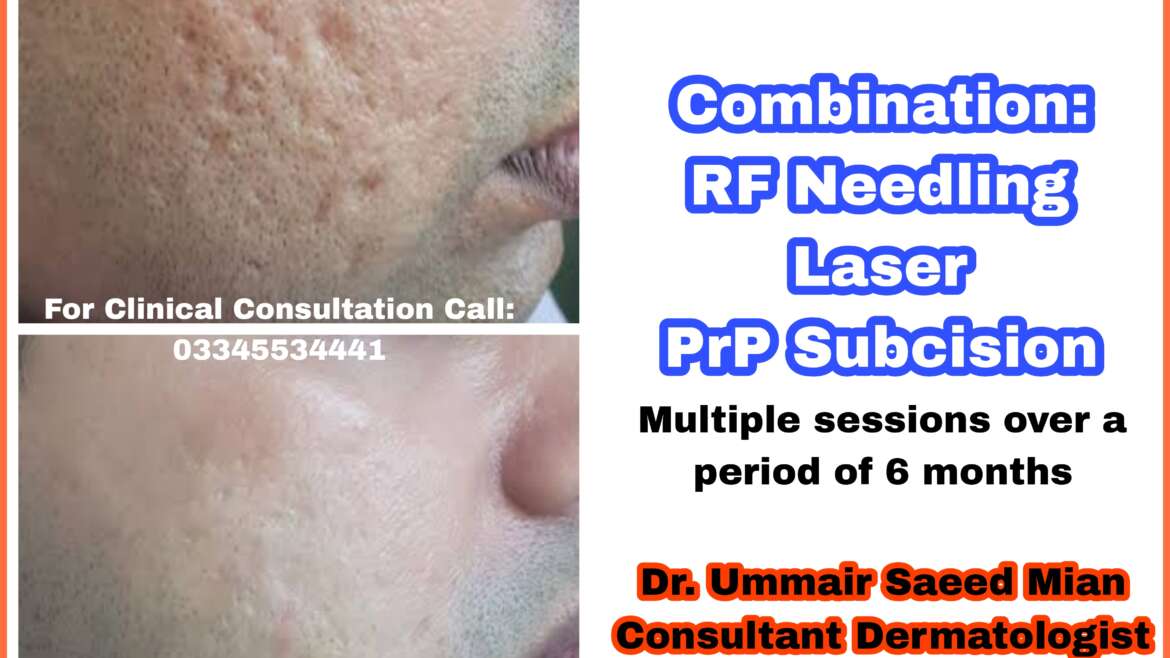
Restoring Confidence: A Comprehensive Guide to Acne Scars
What Are Acne Scars? True acne scars are more than just dark spots (which is hyperpigmentation); they are permanent textural changes in the skin. They occur when severe acne damages the deep layers of the dermis, causing the body to produce either too little collagen (resulting in depressed or “pitted” scars) or too much collagen (resulting in raised or keloid scars).
Because different scars sit at different depths, treating them requires a sophisticated, multi-layered medical approach. There is no single “magic cream” that can lift a depressed scar; it requires physical remodeling of the skin tissue.
The Gold Standard: Combination Therapy
The most important fact to understand is that acne scars are rarely uniform. A single patient often has a mix of “Ice Pick” (deep pits), “Boxcar” (sharp depressions), and “Rolling” (wave-like) scars.
Therefore, relying on just one machine or method will yield limited results. At our clinic, we utilize a Combination Protocol—layering different technologies in a single plan to target every type of scar effectively.
Our Advanced Treatment Options
We customize a plan based on the depth and type of your scarring using the following medical-grade procedures:
1. TCA CROSS (Chemical Reconstruction) Specifically for deep, narrow “Ice Pick” scars. We carefully apply high-strength Trichloroacetic Acid (TCA) into the base of the scar. This stimulates an intense healing response, causing the scar to “fill up” from the bottom.
2. Subcision Essential for “Rolling” scars. These scars are pulled down by fibrous bands (tethers) under the skin. Using a specialized needle or cannula, we manually break these tethers to release the skin, allowing it to spring back up to a smoother level.
3. Energy-Based Devices (Lasers & RF)
-
CO2 Fractional Laser: The most powerful tool for skin resurfacing. It vaporizes columns of tissue to remove rough edges and force massive collagen regeneration.
-
RF Microneedling (MNRF): Delivers heat energy deep into the dermis without damaging the surface. This tightens the skin and improves texture with minimal downtime.
4. Biostimulators (PRP & Exosomes) We often combine the above treatments with Platelet-Rich Plasma (PRP) or PRGF or GFC or Exosomes. These are “healing boosters” that reduce downtime and supercharge the collagen production process, giving better results than the laser alone.
Realistic Expectations & Sessions
Treating acne scars is a marathon, not a sprint. It is a biological process of rebuilding skin that takes time.
-
Improvement Goals: The goal is significant improvement (50% to 80%), not absolute perfection.
-
Timeline: Collagen remodeling continues for 3-6 months after your last session.
-
Number of Sessions: Depending on severity, most patients require 4 to 6 sessions, spaced 4-6 weeks apart.
Why Consultation is Mandatory
You cannot simply “book a laser session” for scars. A detailed consultation with Dr. Ummair Saeed Mian is the first step.
-
Scar Mapping: We must identify which types of scars you have to choose the right tools (e.g., Lasers won’t fix tethered scars; they need Subcision first).
-
Active Acne Control: We cannot treat scars if you still have active acne breakouts. We must stabilize your skin first to prevent new scarring.
-
Custom Blueprint: We will design a tiered plan that may alternate between lasers, peels, and subcision for the most cost-effective and visible results.